Leica M9 Sensor Repair – Sensor Glass Replacement for Corrosion Damage
Professional Leica M9 CCD repair service in Europe
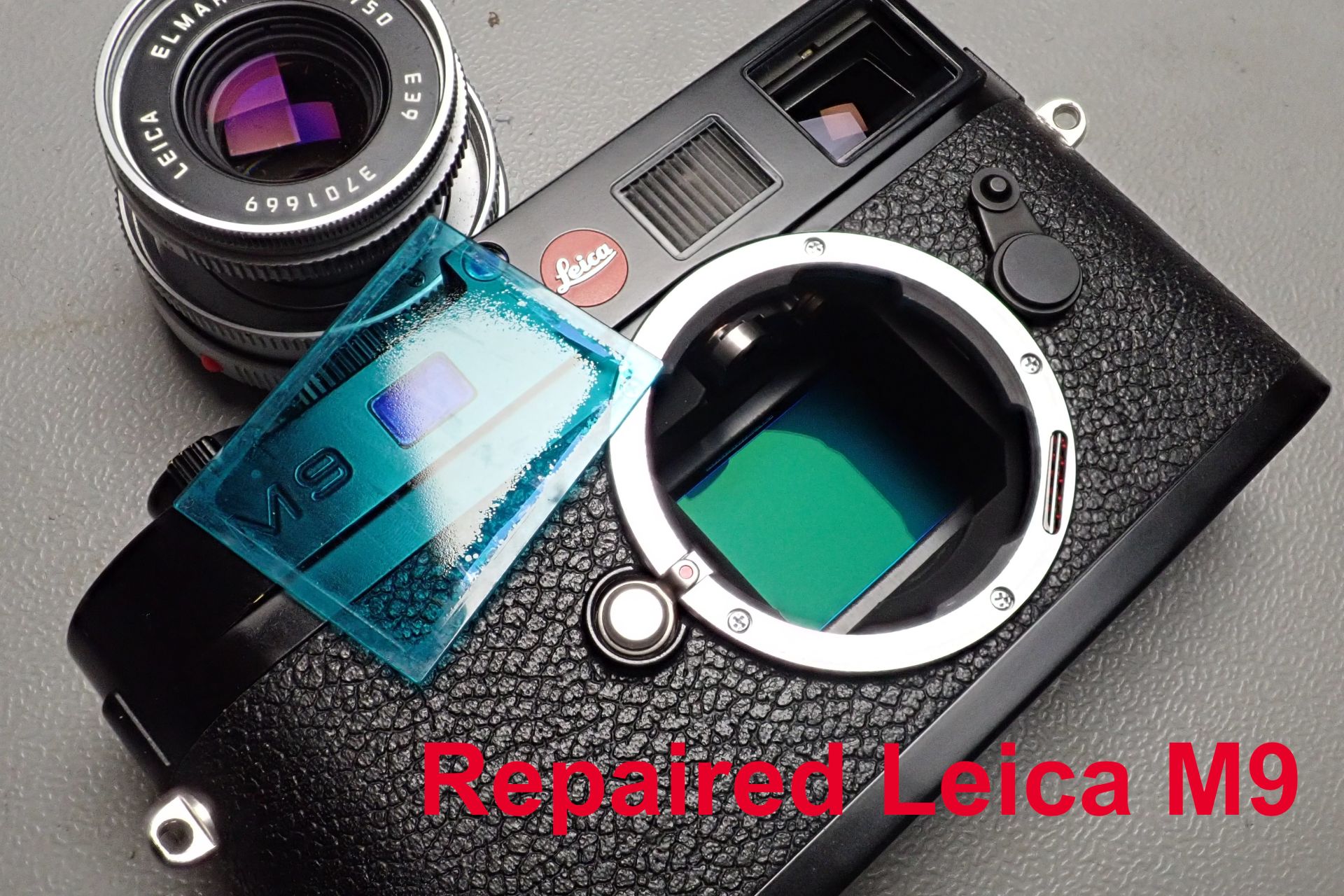
We replace the damaged filter on the sensor of your Leica camera
Two-Step Process
- Sending the camera: You order the item “Leica-M9-Inspection” and send us your Leica M9. We carefully check whether replacing the defective filter is possible. We repair all Leica M9 models (Standard, M9M, M9-P, M-E, Titanium).
-
Repair: In around 9 out of 10 cases, the repair is possible. After our confirmation, you purchase the item “Leica-M9-CCD-Repair”.
If the repair is not economically feasible, we return the camera unrepaired. Note: The price for “Leica-M9-Inspection” covers return shipping costs for an adequately insured DHL parcel.
Shipping & Repair Time
Please send your Leica well packed and fully insured in neutral packaging. Accessories and battery are not required. Please remove the memory card.
Due to the high technical requirements, repairs may take up to 12 weeks in exceptional cases. A more precise estimate can be provided on request at any time.
Our Repair Service Includes
- Removal of the defective filter
- Installation of a new corrosion-resistant special filter
- Fine adjustment of optical properties
- Comprehensive final image quality control
- 24-month warranty on the filter glass
Technical Background
Many Leica M9 cameras suffer from what is commonly known as sensor corrosion. The cause is the degradation of the IR-cut filter.
Our solution: we replace the damaged filter glass with Schott BG61 glass, which is optically compatible with the original Leica filter.
The images show sample photos taken with damaged Leica cameras alongside images taken with repaired sensors. These are real images from multiple repaired cameras.
Important Note
In many Leica M9 cameras affected by sensor corrosion, we have recently identified an additional issue.
Along with the progressive degradation of the filter glass, the ceramic adhesive bonding the glass to the sensor also begins to break down. This produces an oily liquid consisting of sulfuric acid.
This liquid forms at the edges under the filter glass and can migrate inward, reaching the delicate microlenses on the sensor. This can cause permanent damage. It may also destroy the golden bond wires that control the sensor. This acid ultimately leads to sensor failure.
Why is quick repair important?
Over time, the adhesive continues to degrade, producing more acid and increasing the risk of irreversible sensor damage. Early intervention and cleaning are therefore critical.
What does this mean for the repair?
During glass removal, the acid must be removed completely and with extreme care. Despite the highest level of precision, there is always a risk that a drop of this aggressive liquid reaches the microlenses or that bond wires have already been damaged. In such cases, the sensor may be irreparably damaged.
Our advanced repair method
After extensive development, we have created our own process that allows us to remove the acid without residue. In addition, we are able to repair damaged bond wires to a certain extent. We continuously improve our methods and tools.
We inform the customer in the cost estimate whether the camera shows only classic sensor corrosion or is also affected by the acid issue. If the acid issue is present, repair is still possible. The price remains unchanged. However, we require a waiver for potential consequential damages, as the risk originates from the pre-existing acid, not from our work.
Vertical Rangefinder Adjustment
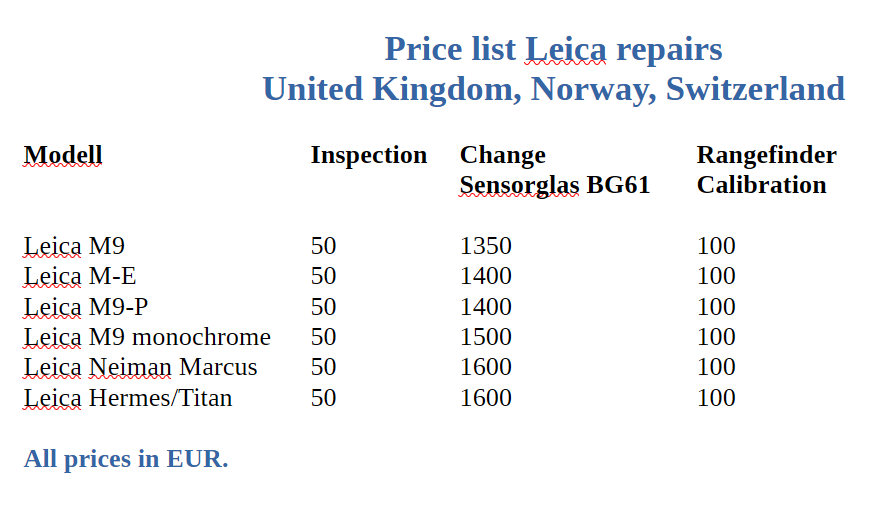
If necessary, we recalibrate the rangefinder. If images appear vertically misaligned during focusing, we recommend this adjustment.
Camera Leather Replacement
In addition to sensor repair, we also offer replacement of the camera leatherette. Worn parts are replaced with high-quality material (additional cost: €50).
Our Repair Experience & Method (Update)
Over the past year, we have successfully repaired over two dozen Leica M9 corrosion sensors using a highly specialized process developed in-house. This method is based on several hundred hours of research and practical development and represents proprietary know-how.
Unlike many other camera systems, the Leica M9 sensor glass is bonded with a ceramic adhesive that cannot be removed by heat or standard chemical processes. The only way to remove the damaged glass is through precise mechanical work under a microscope.
This process is extremely demanding:
During removal, microscopic debris is created that must never come into contact with the sensor surface. Even minimal residue can lead to visible defects or reduced image quality. Achieving a 100% clean result requires hours of meticulous manual work.
A critical detail is the level of precision required:
While one might assume the work is done millimeter by millimeter along the sensor edge, the reality is far more delicate. We work in fractions of a millimeter (tenths of a millimeter), carefully progressing step by step to ensure that no adhesive particles reach the sensor surface.
A single Leica sensor repair therefore takes an entire working day. When considering the level of expertise and precision required, this explains the cost of such a repair.
This is fundamentally different from many other camera manufacturers, where the filter glass can be replaced relatively quickly. In Leica M9 cameras, the process is significantly more complex and carries inherent risks.
In addition, many affected sensors suffer from the well-known acid problem. We are able to handle this issue to a certain extent and, in some cases, even repair damaged bond wires. However, these steps require additional time, precision, and always involve a residual risk due to the pre-existing damage.
About the Replacement Filter
Our replacement glass is carefully selected to match the optical properties of the original Leica filter as closely as possible. The key difference is not in image quality, but in material stability:
The original Leica filter offered excellent optical performance. However, it degraded over time due to material limitations. Our solution is specifically designed to avoid this long-term failure.
This means:
You retain the original image characteristics of your Leica while benefiting from significantly improved durability.
After repairing numerous Leica M9 sensors, we can confidently say:
We deliver consistently excellent and reliable results. Our process continues to improve, and already today we offer a level of quality that meets the highest expectations for this type of repair.
Experience & Trust
Over 5,000 cameras and lenses have already been repaired and modified by us. More than a thousand positive eBay reviews build trust.
Questions? Call us – our contact details can be found in the legal notice.
Leica M9 Sensor Reparatur Service in Europa
Unser Leica M9 Reparaturservice gehört zu den wenigen spezialisierten Angeboten in Europa, die sich auf die Reparatur von CCD-Sensoren bei Korrosion konzentrieren. Besonders bei der Leica M9 ist die Sensorkorrosion ein bekanntes Problem, das eine präzise und professionelle Lösung erfordert.
Wir bieten den Austausch des Sensorfilters, die Entfernung von Korrosion sowie die Wiederherstellung der Bildqualität Ihrer Leica Kamera. Unser Service richtet sich an Kunden aus Deutschland, Österreich, Tschechien und ganz Europa.
Wenn Ihre Leica M9 Flecken aufweist oder typische Korrosionserscheinungen zeigt, ist eine frühzeitige Reparatur entscheidend, um dauerhafte Schäden zu vermeiden.